
In Praise of Parsley
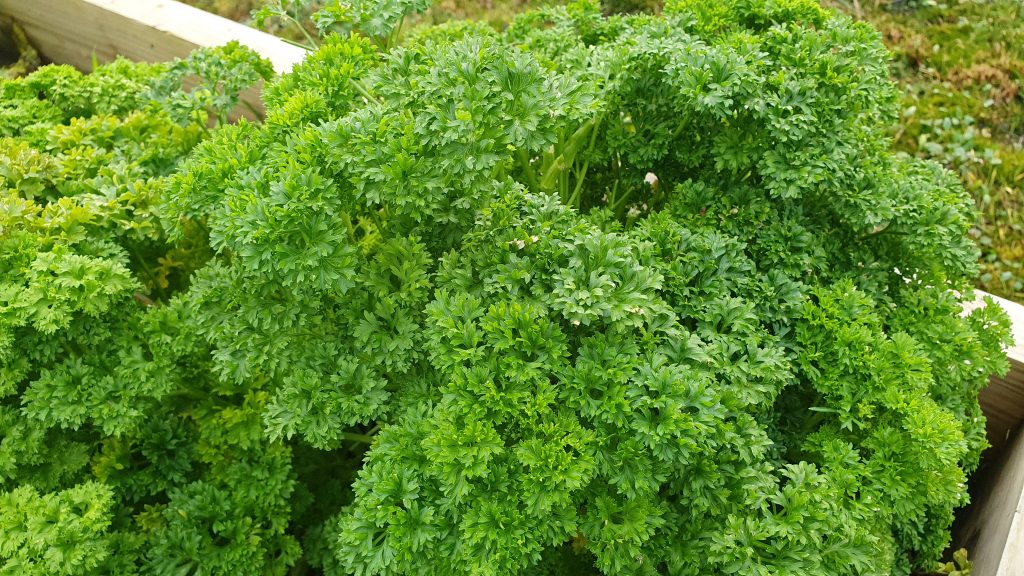
I think that parsley deserves some praise! Although it is often pushed to the side of a plate and forgotten, it actually has a fascinating history and is extremely nutritious, too.
I bought a small plant of parsley (Petroselinum crispum) at the grocery store last summer and put it on my kitchen windowsill so it would be handy for cooking. Once it started to look a bit peaky, I plunked it in a corner of one of my raised garden beds. It proceeded to grow and grow–throughout late summer, fall and now winter. Four days in a row of below freezing temperatures didn’t even faze it!
Maybe this is normal behavior for parsley. I don’t really know because I have never grown it before. (My only real experience with vegetables is growing green beans and tomatoes in the very hot, dry summers of Portland, Oregon.) In any case, I think my parsley is amazing, and I love being able to run out just before dinner to pick some. Parsley just makes me happy somehow.
The History of Parsley
While thinking about my parsley plant, I started to wonder about its history, so I conducted some online research. I discovered that parsley is a biennial plant that is native to the Mediterranean and Western Asia. It is now cultivated, of course, in countries around the world. A relative of celery, its name derives from the Greek word “petroselinon,” which means “rock celery.” (Apparently, parsley grows easily on rocks and walls.) People have cultivated the plant for more than 2,000 years.
Parsley and the Greeks
The Greeks viewed parsley as sacred to the dead and dedicated it to Persephone, the wife of Hades and goddess of the underworld. According to Euripides, Euridice and Lycurgus, the priest of Zeus at Nemea, had an infant son named Opheltes. Unfortunately, his nurse’s attention was momentarily distracted, and a serpent bit and killed him. As blood flowed from the wound, parsley sprang up in its midst. Opheltes was subsequently renamed “Archemorous,” which means “herald of death.”
The Greeks placed wreaths of parsley on tombs and burial grounds. They also made wreaths of it to adorn the heads of victors in the Nemean Games as a reminder that the contest began as a funeral game in honor of Archemorous. In addition, the Greeks had an expression–de’eis thai selinon–that meant “to need only parsley.” This was a euphemism for someone who was close to dying.
Although the ancient Greeks did not eat parsley as food, they did use it as medicine. In fact, Hippocrates (the “Father of Medicine“) recorded it. And in The Iliad, which was written somewhere between 1190 BCE and 850 BCE, Homer mentions feeding parsley to chariot horses to improve their strength and stamina.
Parsley and the Romans
The Romans used parsley at meals to mask the smell of garlic and protect against intoxication. They also covered dead bodies with it to mask the smell of decay.
Parsley began to be consumed in Western Europe as a culinary herb in the Middle Ages. Its use was likely popularized by Charlemagne (748-814 CE). Crowned the Emperor of the Romans in 800 CE, Charlemagne grew parsley extensively in his gardens.
The Romans brought the herb to Britain, where its association with death continued. Parsley is notoriously hard to germinate. Perhaps this is why the legend grew that newly planted parsley seeds went to the devil nine times and back before starting to grow.
The Healing and Nutritional Properties of Parsley
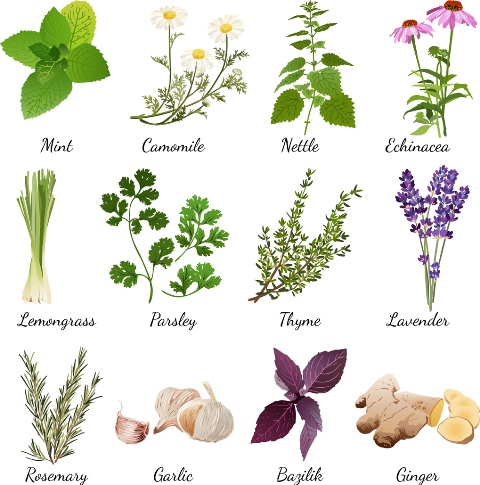
Despite parsley’s mythological association with death, its roots, seeds and leaves have been used to treat numerous health issues for centuries. Examples include bronchitis, toothaches, bladder infections, kidney stones, high blood pressure and digestive disorders. (Even Peter Rabbit knew about the benefits of the plant on digestion. He was looking for parsley to treat his stomachache when he got into trouble in Mr. McGregor’s garden!)
A study published in the Journal of Traditional Chinese Medicine found that parsley has numerous proven pharmacological properties. For example, it is antioxidant, hepatoprotective, neuroprotective, anti-diabetic, anti-ulcer, diuretic, hypotensive, antiseptic, antibacterial and antifungal.
Another reason parsley deserves some praise is that it is an extremely nutritious food. According to Healthline, two tablespoons (8 grams) of parsley provide):
- Calories: 2
- Vitamin A: 12% of the Reference Daily Intake (RDI)
- Vitamin C: 16% of the RDI
- Vitamin K: 154% of the RDI
As you can see, parsley is a particularly good source of vitamin K, which is necessary for blood clotting and bone health. It is also rich in antioxidants, such as vitamin C, that help to prevent cellular damage from molecules called free radicals. It is particularly rich in a class of antioxidants known as flavonoids, which have been shown to help lower the risk of colon cancer, type 2 diabetes and heart disease.
Parsley vs Kale
Many people in the world of nutrition have been emphasizing the positive health benefits of eating leafy greens such as kale, spinach, chard and collard greens. Parsley isn’t mentioned as often, but it should be. In fact, a comparison of kale and parsley finds that both plants are high in Vitamin A, Vitamin C, calcium, dietary fiber and potassium. Kale has more riboflavin, but parsley contains more folate. Both kale and parsley contain significant amounts of thiamin, niacin, pantothenic acid and vitamin B6. And parsley is an excellent source of iron.
Specifically:
- Kale has 93.4mg of vitamin C per 100 grams whereas parsley has 133mg of vitamin C.
- Kale has 241ug of vitamin A per 1S00 grams whereas parsley has 421ug of vitamin A.
- Kale has 254mg of calcium per 100 grams whereas parsley has 138mg of calcium.
- Kale has 1.6mg of iron per 100 grams whereas parsley has 6.2mg of iron.
- Kale has 348mg of potassium per 100 grams whereas parsley has 554mg of potassium.
Clearly, Parsley Deserves Some Praise and Attention!
All of these findings demonstrate excellent reasons to consume parsley regularly–not simply as a forlorn, ignored sprig at the edge of a plate, but as a nutritious vegetable on the par with kale and other leafy greens!
